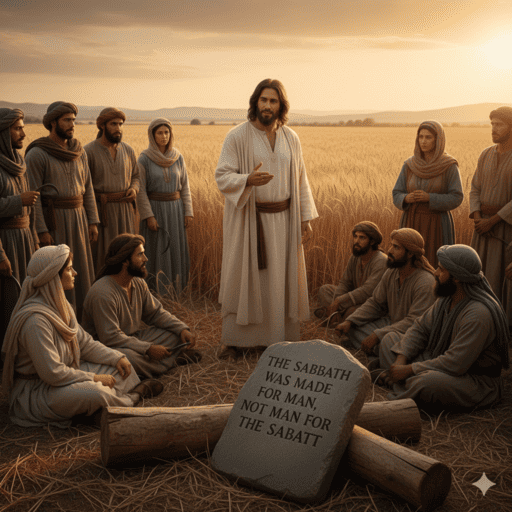

When Jesus said, “The Sabbath was made for man, not man for the Sabbath” (Mark 2:27), he was underscoring that God designed the Sabbath as a gift for humanity’s benefit—a day intended for rest, worship, and genuine renewal, rather than an occasion for unbearable restrictions or burdens.
This statement highlights the compassionate intent behind the Sabbath: it is not about enforcing rigid laws, but about promoting human flourishing and kindness, with Jesus affirming his unique authority over this sacred day.
Biblical Background
To appreciate Jesus’ perspective, we first need to understand the Sabbath’s origin and significance. The Sabbath traces its roots to the creation story in Genesis, where God rested on the seventh day and blessed it as a day of rest (Genesis 2:2-3).
Later, in the Ten Commandments, God instructs: “Remember the Sabbath day, to keep it holy… on it you shall not do any work” (Exodus 20:8-10).
The Sabbath was about more than just legalism or ritual; it was meant to be a delight—a weekly pause to remember God’s provision and enjoy the goodness of creation. A time to spend with our Creator and know Him more.
Over time, however, additional rules and interpretations were developed to “protect” the sanctity of the day, some of which turned the observance into a heavy burden for many.
Jesus’ Teachings about the Sabbath
When Jesus began His ministry, He encountered a context where Sabbath rules guarded every aspect of life—from what you ate, to how far you could walk, to the most basic household tasks.
It is against this backdrop that Jesus made His remarkable claim: “The Sabbath was made for man, not man for the Sabbath.”
In Mark 2:23-28, we find one of Jesus’ most well-known Sabbath encounters. Walking through grainfields with His disciples, they plucked heads of grain to eat—technically, a violation in the eyes of strict observers.
When challenged by the Pharisees, Jesus reminded them of King David, who ate consecrated bread when in need. He concluded, “The Sabbath was made for man, not man for the Sabbath. So the Son of Man is Lord even of the Sabbath.”
This was not merely a correction of a minor detail; Jesus was affirming that the Sabbath existed to bless humanity, not trap them in endless legal obligations.
Miracles and Healings on the Sabbath
Time and time again, Jesus healed people on the Sabbath, turning moments that could have been divisive into opportunities to reveal God’s compassion.
Consider the story in Luke 13:10-17, where Jesus heals a woman crippled for eighteen years. The synagogue leader protests, insisting that healing constitutes “work” and should not be done on the Sabbath.
But Jesus responds, “Should not this woman, a daughter of Abraham, whom Satan has kept bound for eighteen long years, be set free on the Sabbath day?” Similarly, in John 5, Jesus heals a lame man and, once again, faces accusations of breaking Sabbath law.
In each instance, Jesus highlights the value of mercy over rigid observance. It was not that He intended to abolish the Sabbath, but to restore it to its intended purpose: a gift, not a burden.
Jesus’ Interpretation vs. Traditional Observance
Jesus clashed most often with the Pharisees, who held very strict interpretations of Sabbath law. For them, preserving the holiness of the day meant erecting elaborate fences to prevent even the possibility of breaking it. However, this led to rules that often ignored real human needs and suffering.
Jesus, on the other hand, honored the original purpose of the Sabbath. His approach could be summed up in Matthew 12:7: “If you had known what these words mean, ‘I desire mercy, not sacrifice,’ you would not have condemned the innocent.”
He emphasized compassion, healing, and doing good—even (or especially) on the Sabbath.
In this way, Jesus called people back to God’s true intention—that the Sabbath should promote life, joy, freedom, and human belonging, not stifle it with relentless rules.
Theological Implications
Jesus’ teachings on the Sabbath offer profound theological insights. First, the Sabbath is presented not as an arbitrary restriction, but as a divine gift—a weekly reminder of God’s desire for our well-being. Human beings are not made to serve the Sabbath; the Sabbath is made to serve human beings.
Second, the Sabbath points ahead to the spiritual rest found in Christ. The rest God offers is not merely physical cessation from labor, but deep, soul-resting peace that comes from trusting in God’s finished work. The writer of Hebrews picks up this theme, inviting believers to enter into God’s rest through faith in Jesus (Hebrews 4:9-11).
Relevance for Christian Practice Today
So, what does all this mean for contemporary Christians? Is Sabbath observance still important?
Of course it is! The fourth commandment is as important as the other nine commandments!
God wants us to worship Him on the day He has blessed and sanctified! (Genesis 2:2-3)
Unfortunately, the majority are worshipping on Sunday, but nowhere is the Bible teaching Sunday worship.
Rest is essential for our well-being. God designed us to need regular rhythms of rest, renewal, and worship. Ignoring Sabbath principles can lead to burnout, stress, and a diminished relationship with God.
Sabbath is about relationship. Far from being a legalistic hurdle, the Sabbath is an invitation into deeper communion with God, family, and community.
Ultimately, Sabbath is less about rules and more about restoration—making space in our busy lives to rest, remember, and reconnect with what matters most – our Creator.
Conclusion
The words of Jesus remain as significant now as when they were first spoken: “The Sabbath was made for man, not man for the Sabbath.” In a world that glorifies busyness and productivity, the call to Sabbath is radical. It is a call to slow down, to let go of striving, and to find our true rest in Christ.
By reclaiming the Sabbath as God intended—a time of joy, freedom, mercy, and renewal—we discover the heart of Jesus, who invites us: “Come to me, all you who are weary and burdened, and I will give you rest” (Matthew 11:28).
References:
Genesis 2:2-3
Exodus 20:8-10
Mark 2:23-28
Matthew 12:1-14
Luke 13:10-17
John 5:1-18
Hebrews 4:9-11
My Letter To A Sunday Keeper – Sabbath Documentary

The Days of Noah – Powerful Documentary (Video Format)

Bible Studies – Written Format