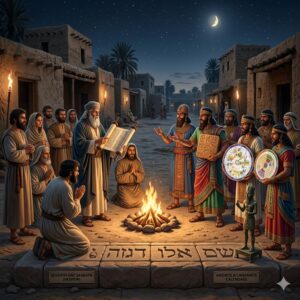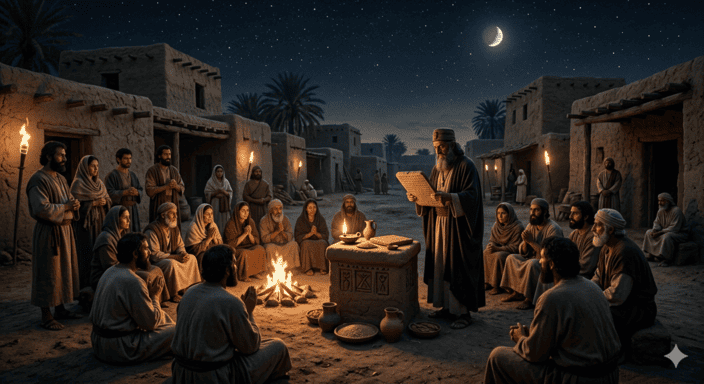

The Sabbath originates in the divine act of creation as recorded in the Word of God.
Scripture reveals that God Himself established the seventh day as a holy day of rest — not as a cultural borrowing from surrounding nations, but as a sacred institution woven into the fabric of creation itself. As the first book of Scripture declares:
“And on the seventh day God ended his work which he had made; and he rested on the seventh day from all his work which he had made. And God blessed the seventh day, and sanctified it: because that in it he had rested from all his work which God created and made.” — Genesis 2:2–3 (KJV)
While ancient Mesopotamian cultures did observe periods of rest or taboo days tied to lunar cycles, these bear only a superficial resemblance to the biblical Sabbath.
Any similarities point not to Israel copying pagan practice, but to the universal human awareness of the seventh day — an echo of Eden impressed upon the conscience of mankind since the beginning.
The following sections examine the ancient Near Eastern context through a biblically grounded lens, showing how the sacred Sabbath stands apart from and above all human counterparts.
Ancient Mesopotamian Rest Days
Ancient Mesopotamian civilizations — particularly Sumerian and Babylonian societies — observed days on which certain activities were restricted or considered inauspicious.
These were not days of worship or communion with their gods in any redemptive sense, but rather days of omen and avoidance, tied to the movements of the moon and stars rather than to any moral or covenantal framework.
The Babylonians observed what scholars have called “evil days” — primarily the 7th, 14th, 19th, 21st, and 28th days of the lunar month.
On these days, the king was prohibited from certain activities, physicians could not practice, and diviners were constrained.
The character of these days was fundamentally negative — rooted in fear of malevolent spiritual forces rather than joyful rest in a Creator God.
By stark contrast, the biblical Sabbath is a gift, not a taboo. The Lord blessed and hallowed the day, inviting His people to enter His own rest as an act of covenant love.
Isaiah records God’s own words about the Sabbath’s positive character:
“If thou turn away thy foot from the sabbath, from doing thy pleasure on my holy day; and call the sabbath a delight, the holy of the LORD, honourable…” — Isaiah 58:13 (KJV)
No Babylonian “rest day” was ever called a delight. The Mesopotamian observances were marked by dread; the biblical Sabbath is marked by delight, holiness, and fellowship with the living God.
The Akkadian Word for Sabbath
Scholars have long noted a linguistic connection between the Hebrew word Shabbat (שַׁבָּת) and the Akkadian term shapattu or shabbatu, which referred to the day of the full moon — the fifteenth day of the lunar month.
Some have argued this etymology proves the Sabbath was borrowed from Babylonian moon worship. A careful examination of the evidence, however, does not support this conclusion.
The Hebrew root shabat (שָׁבַת) means simply “to cease” or “to rest,” a meaning grounded entirely in the theological narrative of Genesis.
When God made the Sabbath, there were only Adam and Eve in existence, our first parents.
The Akkadian shapattu carried no meaning of ceasing from labor; it was a calendar marker tied to the lunar cycle. The resemblance in sound is superficial, and the conceptual gulf between them is immense.
The biblical Sabbath is independent of the lunar calendar. It falls on the seventh day of a continuous weekly cycle — a cycle that does not reset with the moon and does not depend on astronomical observation.
This distinction is foundational. The week with its seventh-day rest was instituted at Creation, before Israel had any contact with Mesopotamian culture:
“For in six days the LORD made heaven and earth, the sea, and all that in them is, and rested the seventh day: wherefore the LORD blessed the sabbath day, and hallowed it.” — Exodus 20:11 (KJV)
The fourth commandment itself appeals not to any Akkadian tradition but directly to the creation week. The Sabbath’s authority is rooted in God’s own example, not in any human linguistic or cultural precedent.
Babylonian Calendar and Sacred Days
The Babylonian calendar was a lunisolar system in which months began with the new moon. Within this framework, certain days — particularly those falling on multiples of seven within the month — carried special religious or administrative significance.
Scholars have examined cuneiform tablets from Mesopotamia that describe restrictions on the king and priests on these days.
It is critical to note that the Babylonian seven-day intervals were not a continuous weekly cycle.
They were counted from the beginning of each new month and thus reset with every lunar month.
The biblical week, by contrast, is a perpetual, unbroken cycle of seven days reaching back to the first week of creation. It is not tied to the moon, the sun, or any astronomical event.
The prophet Amos records God distinguishing the Sabbath sharply from the new moon festivals of Israel’s surrounding neighbors, suggesting these were entirely different types of observance in the mind of God:
“When will the new moon be gone, that we may sell corn? and the sabbath, that we may set forth wheat…” — Amos 8:5 (KJV)
The new moon and the Sabbath are mentioned together here precisely because they are distinct.
The Sabbath belongs to a different order — the order of Creation — not to the monthly lunar cycle that governed Babylonian religious observance.
The Full Moon Theory of the Sabbath
The “full moon theory” of the Sabbath, popularized in the late nineteenth and early twentieth centuries by scholars such as Friedrich Delitzsch and others of the so-called Babel-Bible school, proposed that the Israelite Sabbath evolved from Babylonian lunar observances — specifically from shapattu, the fifteenth day of the month corresponding to the full moon.
This theory has largely been abandoned by modern scholars due to insurmountable problems.
The most decisive is the discontinuity between the Babylonian lunar marker and the unbroken seven-day cycle of Scripture.
The full moon occurs once a month, not every seven days. There is no mechanism by which a monthly lunar event transforms into a continuous weekly cycle without any historical documentation of such a transition.
Furthermore, the earliest records of Hebrew religious practice already show the Sabbath operating as a seventh-day weekly institution.
The manna narrative in Exodus predates the giving of the law at Sinai, yet it already presupposes a functioning seven-day week with a distinct seventh day:
“And he said unto them, This is that which the LORD hath said, To morrow is the rest of the holy sabbath unto the LORD… Six days ye shall gather it; but on the seventh day, which is the sabbath, in it there shall be none.” — Exodus 16:23, 26 (KJV)
The people already understood what the Sabbath was before the Ten Commandments were formally codified at Sinai.
This demonstrates that the Sabbath was not invented by Israel in contact with Babylon, but was a pre-existing institution — one entirely consistent with its Genesis origin.
Archaeological Evidence
Archaeological discoveries from Mesopotamia — including the great library of Ashurbanipal at Nineveh, excavated in the nineteenth century — have yielded cuneiform texts describing Babylonian calendar observances.
Tablets referencing auspicious and inauspicious days have been found, along with liturgical texts connected to the moon god Nanna/Sin and the Enuma Elish creation epic, which describes the gods resting after creation.
These finds have sometimes been interpreted as proof that Israel’s Sabbath and even its creation narrative were derived from Babylonian sources.
However, the biblical perspective is precisely the reverse: the Babylonian accounts are corrupted echoes of the true history recorded in Genesis.
Moses, writing under divine inspiration, preserved the accurate account of creation and the Sabbath that the nations around Israel had distorted through centuries of idolatry.
Archaeological evidence from Israel itself, including inscriptions and ostraca from the period of the monarchy, confirms that the Sabbath was a consistently observed and distinctly Israelite institution.
The Elephantine papyri from the Jewish community in Egypt likewise attest to Sabbath observance as a defining marker of Jewish identity among Diaspora communities.
The testimony of Scripture remains the most reliable guide. The Sabbath is not a fossil of Mesopotamian moon worship — it is the seal of the living Creator God stamped upon time itself from the very first week of the world’s existence:
“Remember the sabbath day, to keep it holy. Six days shalt thou labour, and do all thy work: But the seventh day is the sabbath of the LORD thy God: in it thou shalt not do any work…” — Exodus 20:8–10 (KJV)
The word “remember” in the commandment is itself significant. Israel was not being introduced to a new concept; they were being reminded of what had been established at the foundation of the world.
The Sabbath antedates every Mesopotamian civilization, every Babylonian calendar, and every Akkadian tablet ever inscribed. Its origin is not Babylon — its origin is Eden. (Genesis 2:2-3)
References
- Bottéro, Jean. Religion in Ancient Mesopotamia. University of Chicago Press, 2001.
- Jacobsen, Thorkild. The Treasures of Darkness: A History of Mesopotamian Religion. Yale University Press, 1976.
- Oppenheim, A. Leo. Ancient Mesopotamia: Portrait of a Dead Civilization. Revised ed. University of Chicago Press, 1977.
- Horn, Siegfried H. “Archaeology and the Sabbath I: Was the Sabbath Known in Ancient Babylonia?” Review and Herald, May 4, 1961.
- Hasel, Gerhard F. “The Sabbath in the Pentateuch.” In The Sabbath in Scripture and History, ed. Kenneth Strand. Review and Herald, 1982.
- Dalley, Stephanie. Myths from Mesopotamia. Oxford University Press, 1989.
- Freedman, David Noel, ed. The Anchor Bible Dictionary, 6 vols. Doubleday, 1992. (Vol. 5, pp. 849–856, “Sabbath.”)
- Langdon, Stephen H. Babylonian Menologies and the Semitic Calendars. British Academy / Oxford University Press, 1935.
- Hallo, William W. “New Moons and Sabbaths.” In Essential Papers on Israel and the Ancient Near East, ed. Frederick E. Greenspahn. NYU Press, 1991.
- Nemet-Nejat, Karen Rhea. Daily Life in Ancient Mesopotamia. Greenwood Press, 1998.
- Delitzsch, Friedrich. Babel und Bibel (Babel and Bible). J.C. Hinrichs, 1902–1903.
- Hasel, Gerhard F. “The Polemic Nature of the Genesis Cosmology.” Evangelical Quarterly 46 (1974): 81–102.
- Heidel, Alexander. The Babylonian Genesis. 2nd ed. University of Chicago Press, 1951.
- Hess, Richard S., and David T. Tsumura, eds. I Studied Inscriptions from Before the Flood. Eisenbrauns, 1994.
- Smith, George. Assyrian Discoveries: An Account of Explorations and Discoveries on the Site of Nineveh, during 1873 and 1874. Scribner, Armstrong & Co., 1875.
- Pritchard, James B., ed. Ancient Near Eastern Texts Relating to the Old Testament (ANET). Princeton University Press, 1950.
- Finkelstein, Israel, and Neil Asher Silberman. The Bible Unearthed. Free Press, 2001.
- Schneider, Tammi J. An Introduction to Ancient Mesopotamian Religion. Eerdmans, 2011.
- Hasel, Michael G., and Frank M. Hasel. How to Interpret Scripture. Pacific Press, 2020.
My Letter To A Sunday Keeper – Sabbath Documentary

The Days of Noah – Powerful Documentary (Video Format)

Bible Studies – Written Format