
If you’ve ever wondered what the Pharisees actually taught about the Sabbath — what kinds of actions they considered forbidden, how those rules were developed, and why they became such a flashpoint in Jesus’ ministry — you’re in the right place.
This article walks through the biblical foundation of the Sabbath, how the Pharisees expanded it into an elaborate legal system, what the Mishnah records about forbidden labor, and what Jesus’ repeated conflicts with the Pharisees reveal about the difference between divine command and human tradition.
The Biblical Sabbath: A Day of Rest and Covenant
The Sabbath originates in Genesis, where God rested on the seventh day and set it apart as holy. (Genesis 2:2-3)
When God gave Moses the 10 commandments, the instruction was clear: cease from labor on the seventh day, let your household rest, and remember the sabbath day. The Hebrew word shabbat simply means “rest.” (Exodus 20:8-11)
The Sabbath was not just a practical rule about time management — it was a covenant sign between God and Israel, a weekly declaration that the people belonged to Him. (Ezekiel 20:12)
The prophets reinforced this, and the Law tied Sabbath-keeping to holiness, blessing, and the well-being of the entire community, including servants and strangers within the gate (Exodus 20:8–11; Deuteronomy 5:12–15).
What the original command did not do was provide an exhaustive definition of what constituted “work.” That ambiguity would prove significant.
Who Were the Pharisees?
The Pharisees were a prominent sect within Second Temple Judaism, active from roughly the second century BCE through the first century CE.
They were not the priesthood — that was the Sadducees’ domain — but they wielded enormous influence over ordinary Jewish life through their role as interpreters of the Law.
Their core conviction was that alongside the written Torah given to Moses, there existed an oral tradition transmitted through generations of teachers, which provided the practical details needed to live out the written commandments.
This oral tradition was, in their view, as authoritative as Scripture itself. It was this body of teaching that would eventually be compiled in written form as the Mishnah, around 200 CE.
The Pharisees prided themselves not only on following the 613 commandments of the Mosaic Law, but on following the elaborate interpretive traditions that had grown up around them. The Sabbath was their crown jewel.
From One Command to Thousands of Rules
The written Torah commanded rest on the Sabbath but left the definition of “work” largely unspecified.
The Pharisees and their successors saw this as a problem requiring solution. If you didn’t know precisely what work was, how could you be certain you weren’t violating the commandment?
Their answer was to build what was sometimes called a “fence around the Law” — a set of additional restrictions designed to ensure that no one would inadvertently stray into the territory of the actual prohibition.
The logic was protective, but the outcome was an avalanche of rules.
The Mishnah’s tractate Shabbat codifies 39 primary categories of forbidden labor (Mishnah Shabbat 7:2). These are not arbitrary — they are organized thematically around productive activities:
- The first 11 relate to the production and preparation of bread: sowing, plowing, reaping, binding sheaves, threshing, winnowing, selecting, grinding, sifting, kneading, and baking.
- The next 12 apply to the preparation of clothing, from shearing sheep through spinning, dyeing, weaving, and sewing.
- Seven more cover the processing of animal hide for food or leather.
- The remaining nine deal with writing, building, kindling and extinguishing fires, and transporting objects from one domain to another.
Each of these 39 categories spawned further sub-categories, producing what one scholar estimated as roughly 1,500 individual rules in the Mishnaic tradition.
Every aspect of daily life was touched. The goal of protecting the Sabbath had become a system of surveillance over it.
What the Pharisees Actually Prohibited
The specific applications of these rules give a sense of just how granular the tradition became. Some examples:
On carrying: You could not carry an object across the boundary between a private and public domain.
Moving a chair across a room could become a violation if it crossed certain thresholds. A man healed by Jesus was rebuked for carrying his mat home — an act of obvious gratitude became, in their framework, a Sabbath infraction (John 5:10).
On writing: Writing two or more letters on the Sabbath — even jotting a brief note — was considered work and therefore prohibited.
On agriculture: Reaping ranked third among the 39 forbidden labors. Accordingly, even plucking a head of grain from the stalk could be classified as harvesting. The tradition went further: you were not to look in a mirror on the Sabbath lest you be tempted to pluck a gray hair, which would constitute reaping.
On spitting: Spitting on bare ground was forbidden because it could spread moisture and loosen soil — which might be construed as plowing. Spitting on a rock was acceptable.
On food: Eating a radish was permitted, but dipping it in salt was debated, because leaving it too long in the salt could pickle it — and pickling was a form of preserving, which was a form of work. The Pharisees reportedly deliberated over how long it took to pickle a radish.
On walking: You were not permitted to walk beyond a certain distance — a “Sabbath day’s journey,” roughly 2,000 cubits — from your home.
On eggs: An egg laid by a hen on the Sabbath was forbidden for eating, on the grounds that it represented labor performed on that day — the hen’s labor.
These are not caricatures. They are drawn from the Mishnaic and Talmudic traditions that grew out of Pharisaic legal interpretation.
The original intent of protecting Sabbath holiness had generated an elaborate legal architecture that governed nearly every waking moment of the day God had set apart for rest.
The Historical Context: Second Temple Judaism
It is worth pausing to understand why this development happened when it did. In the period of Second Temple Judaism — roughly 516 BCE to 70 CE — the Jewish community had endured exile, foreign occupation, and constant pressure from surrounding cultures.
The Law became the primary marker of Jewish identity, especially under Hellenistic and later Roman rule.
Strict Sabbath observance was therefore not merely religious devotion — it was an act of cultural and national identity.
The Pharisees’ meticulous attention to Sabbath rules reflected genuine zeal for covenant faithfulness and a desire to preserve Jewish distinctiveness in a world that threatened to dissolve it.
Their intentions were serious and sincere, even where their methods were misguided.
The oral tradition that developed in this period represented centuries of careful legal reasoning by dedicated scholars.
The Mishnah, which codified it in written form in the third century CE, is an impressive intellectual achievement.
Understanding this context does not excuse the excesses of the system, but it explains how thoughtful people ended up debating how long it takes to pickle a radish.
Jesus and the Pharisees: Sabbath as Battleground
More than any other issue, Sabbath disputes defined the conflict between Jesus and the Pharisees.
The Gospels record multiple direct confrontations, and in each one the same tension is visible: the Pharisees apply their rules mechanically to a situation involving human need; Jesus responds by insisting that the purpose of the Sabbath demands something different.
The Grain-Plucking Incident (Matthew 12:1–8; Mark 2:23–28; Luke 6:1–5)
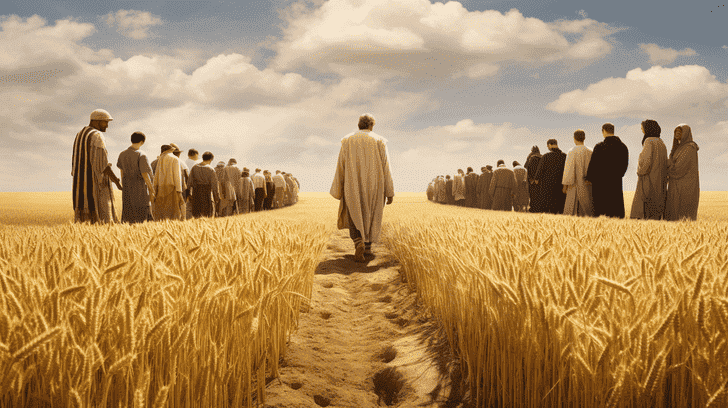
As Jesus and his disciples walked through grain fields on a Sabbath, the disciples plucked heads of grain to eat.
The Pharisees immediately objected: this was reaping, a category-three forbidden labor. Their complaint was not about theft — taking grain for immediate consumption was permitted by Torah (Deuteronomy 23:25) — it was specifically about the Sabbath.
Jesus responded with two counter-arguments. First, He appealed to the precedent of David, who when hungry had entered the house of God and eaten the consecrated bread of the Presence — bread that the Law reserved for priests alone (1 Samuel 21:1–6).
If David’s necessity justified setting aside a sacred restriction, the Pharisees’ own tradition implicitly acknowledged that need could constitute a legitimate exception to legal rules.
Second, Jesus appealed to the priestly service: priests work in the temple on the Sabbath, yet they are held guiltless. The principle of purpose over procedure was already embedded in the system.
Then came His summary statement: “The Sabbath was made for man, not man for the Sabbath” (Mark 2:27). This is the interpretive key to everything that followed.
The Sabbath was given as a gift to human beings — for rest, for renewal, for the worship of God. When its rules are applied in ways that harm rather than help, the rules have become inverted in their purpose.
Healing on the Sabbath (Matthew 12:9–14; Mark 3:1–6; Luke 6:6–11)
Immediately following the grain-plucking episode, Jesus entered a synagogue and encountered a man with a withered hand. The Pharisees watched to see whether He would heal on the Sabbath, prepared to bring an accusation against Him.
Jesus asked them directly: “Is it lawful on the Sabbath to do good or to do harm, to save life or to kill?” The question exposed the logical structure of their position.
The Pharisees’ own tradition permitted emergency action on the Sabbath to save a life.
Jesus pushed the reasoning further: if you would rescue an animal from a pit on the Sabbath without a second thought (which they would), how much more does a human being — made in the image of God — deserve compassion on that day?
He healed the man. The Pharisees’ response, according to Mark, was to begin conspiring against Him.
This was not an isolated incident. The Gospel of John records Jesus healing a paralyzed man at the pool of Bethesda on the Sabbath (John 5:1–18), after which the healed man was confronted for carrying his mat.
John 9 records the healing of a man born blind, which prompted another Sabbath controversy.
In Luke 13, Jesus healed a woman bent double for eighteen years, to the indignation of the synagogue ruler. In Luke 14, He healed a man with dropsy at a Pharisee’s own table.
In each case, Jesus refused to treat healing as a violation of the Sabbath’s purpose. Doing good, restoring a person to wholeness, alleviating suffering — these were not work in the sense the Sabbath prohibited.
They were exactly the kind of activity consistent with a day consecrated to God.
The Deeper Critique: Justice, Mercy, and Faithfulness
At Matthew 23:23, Jesus levels his sharpest critique at the Pharisees: “You tithe mint and dill and cumin, and have neglected the weightier matters of the law: justice and mercy and faithfulness.” This is the interpretive lens through which Jesus viewed all Sabbath disputes.
The Pharisees had not abandoned the Law — they had multiplied it. But in the multiplication, they had lost the hierarchy of values that gives the Law its meaning.
By focusing with forensic precision on which category of labor was being violated, they had lost sight of the human being standing in front of them. The pursuit of ritual correctness had displaced the pursuit of mercy.
When Jesus cited Hosea 6:6 — “I desire mercy and not sacrifice” — He was not improvising a new theology.
The Difference Between Divine Command and Human Tradition
One of the most important distinctions in the Sabbath debates is between what God actually commanded and what the oral tradition added.
The Law of God commanded rest. It prohibited “work” in the sense of productive labor, especially labor for economic gain. It protected servants and strangers from exploitation. It pointed toward creation and covenant.
What it did not command was a debate about radish-pickling timelines, rules about the direction of spit, or the prohibition of carrying a mat by a man recently healed of paralysis.
The Mishnah’s 39 categories represent centuries of careful legal reasoning, and much of that reasoning reflects genuine effort to understand what the Sabbath command requires.
But the cumulative effect, as Jesus named it, was to place heavy burdens on people’s backs (Matthew 23:4) — to transform a day of rest into the most legally treacherous day of the week.
Jesus did not abolish the Sabbath. He affirmed its meaning. He identified himself as “Lord of the Sabbath” (Matthew 12:8), which is a claim not of exemption from its purpose but of authority over its interpretation.
The Sabbath belonged to him; he could say what it required. And what it required, He insisted, was mercy.
What This Means for Understanding the Sabbath Today
The Pharisees’ Sabbath rules are significant not only as historical curiosities but as a case study in how religious traditions develop and what can go wrong in that process.
The impulse to clarify, to protect, and to define is not inherently bad. Precision in religious practice can reflect genuine devotion.
The danger comes when the tradition’s protective layer becomes the substance of the faith — when the fence around the Law is treated as the Law itself, when the category rules become more important than the human being, when the day of rest becomes the most exhausting day of the week.
The biblical Sabbath, as Jesus recovered it, is a gift: a day set apart for rest, for reflection on God’s goodness, for the renewal of the covenant relationship.
It is bound to holiness, but holiness in the biblical sense is not fragility that must be protected from human need.
It is wholeness — the kind of wholeness Jesus kept demonstrating every time He healed someone on the Sabbath and said, in effect, this is what this day is for.
Conclusion
God wants us to enjoy His holy day, to be a day where we gather together to worship Him, and to thank Him for the wonderful gift of salvation in Jesus.
His Son died on the cross for you and me, He took the punishment for our sins, and by His sacrifice, we are free from sin and death.
What a loving Saviour we have! Let us use the Sabbath to reflect and thank God for the wonderful gift of salvation – the cross of Jesus!
My Letter To A Sunday Keeper – Sabbath Documentary

The Days of Noah – Powerful Documentary (Video Format)

Bible Studies – Written Format