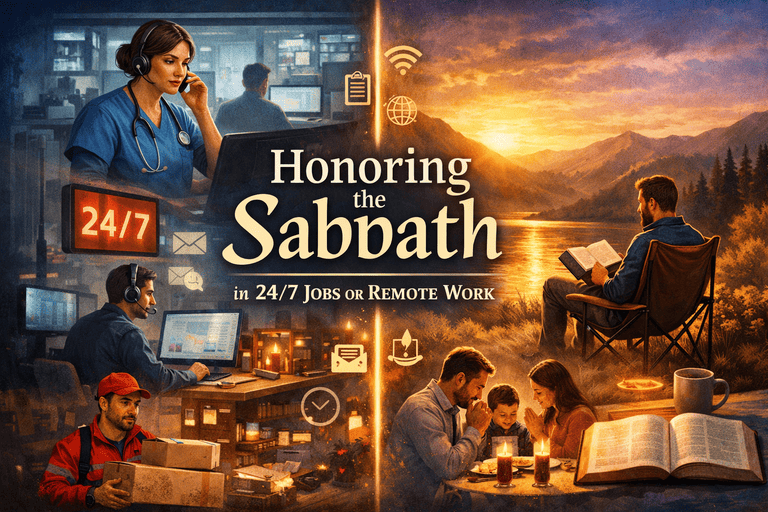

Modern work rarely stops. Healthcare, customer support, logistics, global tech teams, and remote businesses operate across time zones.
For many people, the idea of a true day of rest feels unrealistic. Yet the biblical rhythm of Sabbath was designed for exactly this kind of human pressure: nonstop productivity and mental exhaustion.
If you work in a 24/7 job or remote environment, honoring the Sabbath doesn’t always mean stopping work on the traditional day or following a rigid schedule.
Instead, it means intentionally setting aside a protected period of rest, worship, and renewal that reflects the heart of the Sabbath command. The goal is not legalism but restoration.
This guide explains how to honor the Sabbath when your job never really stops, with practical strategies that work for shift workers, freelancers, remote employees, and entrepreneurs.
Why the Sabbath Still Matters in a Nonstop Work Culture
The modern workplace rewards availability. Notifications, emails, Slack messages, and rotating shifts create the expectation that we are always reachable.
But the Sabbath was created as a counter-pattern to endless work.
Its core purposes include:
- Rest – physical and mental recovery
- Worship – reconnecting with God
- Trust – acknowledging that life and provision do not depend solely on our effort
- Community – time with family and faith communities
Without intentional rest, people experience burnout, emotional fatigue, and spiritual dryness. A consistent Sabbath rhythm helps restore balance.
The Challenge of Honoring Sabbath in 24/7 Work
People in the following roles often struggle the most:
- Healthcare workers
- Emergency services
- Customer support teams
- Hospitality and retail workers
- Remote employees across time zones
- Entrepreneurs and freelancers
- Tech and startup professionals
Common obstacles include:
- Rotating or unpredictable schedules
- International teams requiring weekend availability
- Remote work blurring work-life boundaries
- Fear of falling behind professionally
- Financial pressure to take extra shifts
These challenges are real. But honoring the Sabbath does not require abandoning responsibility—it requires intentional boundaries and flexibility.
Principle 1: Create a Clear “Work Shutdown”
Remote work creates one of the biggest threats to Sabbath: work that never truly ends.
If your laptop is always nearby, your brain never fully disconnects.
A shutdown ritual signals the end of work and the beginning of rest.
Examples include:
- Writing a short list of tasks for the next workday
- Closing all work apps
- Turning off notifications
- Cleaning your workspace
- Saying a short prayer of gratitude
The ritual creates psychological closure, making Sabbath rest more meaningful.
Principle 2: Set Digital Boundaries
Many people technically stop working but remain mentally engaged through notifications.
Digital interruptions can quietly destroy Sabbath rest.
Consider these boundaries:
- Turn off work email notifications
- Mute work Slack channels
- Use “Do Not Disturb” settings
- Inform colleagues of your Sabbath window
- Avoid checking dashboards or analytics
For remote workers especially, digital boundaries are Sabbath boundaries.
Principle 3: Communicate Your Sabbath Early
One of the biggest fears about honoring Sabbath is professional conflict.
Clear communication reduces most problems.
You might say something like:
“I’m unavailable from Friday evening to Saturday evening for personal rest. I’ll respond afterward.
Most managers and teams respect boundaries when they are predictable and communicated early.
For shift workers, request scheduling patterns that allow for a consistent rest day whenever possible.
Principle 4: Plan Rest Intentionally
Many people waste their day off scrolling social media or worrying about work. The result is not true rest.
Sabbath works best when it includes activities that restore you.
Healthy Sabbath practices might include:
- Worship or prayer
- Time in nature
- Unhurried meals with family
- Reading Scripture or spiritual books
- Journaling
- Taking a nap
- Walking without a phone
- Helping those in need
Avoid filling the day with chores or productivity tasks.
Sabbath is not a catch-up day.
Principle 5: Protect the First Hours of Sabbath
The beginning of Sabbath often determines the entire experience.
If it starts with stress, errands, or unfinished work, the rest of the day rarely feels restful.
Instead, start with something intentional:
- Reading Scripture
- Saying a prayer of gratitude
- Sharing a meal with family
- Taking a quiet walk
This moment marks the transition from work mode to rest mode.
Principle 6: Learn to Trust the Pause
The deepest challenge behind Sabbath is often control.
Many professionals fear:
- Losing opportunities
- Missing messages
- Appearing unavailable
- Falling behind
But Sabbath teaches a deeper lesson: life does not depend entirely on our constant effort.
When you stop working for a set period each week, you practice trust—trust that work will continue, that problems can wait, and that rest is not wasted time.
Ironically, people who maintain a Sabbath rhythm often return to work more focused, creative, and emotionally stable.
Sample Sabbath Schedules for Different Jobs
Remote Worker With Global Team
Sabbath: Friday evening – Saturday evening
- Friday 6 PM: Shut down work apps
- Friday night: Family dinner
- Saturday morning: Worship or quiet reflection
- Saturday afternoon: Outdoor walk
- Saturday evening: Light planning for next week
Freelancer or Entrepreneur
Sabbath: Friday sundown – Saturday sundown
- No client emails
- No marketing or analytics checks
- Focus on rest, community, and spiritual practices
Common Mistakes That Ruin Sabbath
1. Treating Sabbath Like a Rule Instead of a Gift
Legalistic pressure often makes people abandon Sabbath entirely.
The purpose is rest and renewal, not perfection.
2. Filling the Day With Chores
Housework, errands, and productivity projects quickly turn rest into another workday.
Prepare ahead of time so the Sabbath remains open and unhurried.
3. Staying Digitally Connected to Work
A single email check can restart your work brain for hours.
Complete disconnection is often necessary.
4. Ignoring Your Personal Energy Needs
Some people rest best socially, while others need solitude.
Design your Sabbath around what genuinely restores you.
The Long-Term Benefits of a Sabbath Rhythm
People who consistently honor Sabbath often experience:
- Lower burnout
- Improved mental clarity
- Greater spiritual awareness
- Stronger relationships
- Healthier work boundaries
- More sustainable productivity
In a world that celebrates constant hustle, Sabbath is an act of countercultural wisdom.
It reminds us that rest is not weakness—it is part of being human.
Final Thoughts
Honoring the Sabbath in a 24/7 work culture requires creativity and intentional boundaries.
Whether you work rotating shifts, manage a remote career, or run your own business, the core principle remains the same: the seventh day of the week is dedicated to rest, worship, and renewal.
By protecting a Sabbath window, setting digital boundaries, and planning restorative activities, even the busiest professionals can reclaim the gift of true rest.
And in a culture that never stops working, that rhythm may be more necessary than ever.
My Letter To A Sunday Keeper – Sabbath Documentary

The Days of Noah – Powerful Documentary (Video Format)

Bible Studies – Written Format