
The account of Jesus healing the man born blind (John 9) is more than a story of physical restoration. It is a sign that exposes spiritual blindness, challenges religious assumptions, and reveals Jesus’ identity.
The miracle unfolds in stages: the question of why the man suffers, the act of healing on the Sabbath, the reactions of religious leaders, and finally a personal encounter in which Jesus discloses who He is.
Theological Discussion of Sin and Suffering
When the disciples see the blind man, they assume a direct link between sin and his condition:
“Who sinned, this man or his parents, that he was born blind?” (John 9:2). They treat suffering as a simple punishment.
Jesus rejects this narrow view. He does not deny that sin is in the world or that it can have consequences, but He refuses to tie every instance of suffering to a specific personal sin.
Instead, He says the man’s blindness is an occasion “that the works of God might be displayed in him” (John 9:3).
This shifts the lens:
Suffering is not always a direct punishment for particular sins.
God can work through suffering to reveal His character and purposes.
The proper response to others’ suffering is not blame, but participation in God’s redemptive work.
The Healing Act
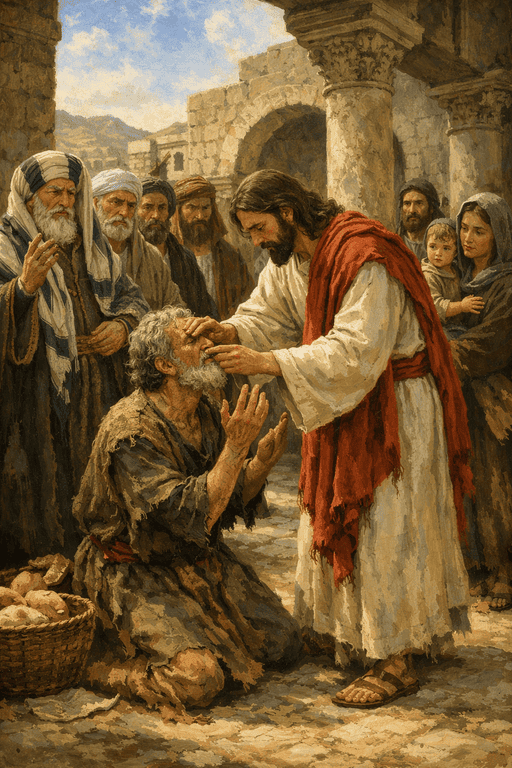
Jesus then acts. He spits on the ground, makes mud with the saliva, anoints the man’s eyes, and tells him to wash in the pool of Siloam. The man obeys and returns seeing.
Several features stand out:
Jesus initiates the healing; the man does not ask.
The use of mud and washing highlights both Jesus’ authority and the man’s obedient trust.
The healing is complete and public; the neighbors recognize him as the same man who used to beg.
The miracle is not only an act of compassion but also a sign that points beyond itself. It enacts what Jesus has already claimed in John’s Gospel: He is the light of the world, bringing sight where there was only darkness.
The Sabbath Controversy
The problem, from the religious leaders’ perspective, is timing. Jesus heals on the Sabbath. By making mud and performing what they consider “work,” he crosses their legal and traditional boundaries.
For some Pharisees, this is decisive: a man who “breaks” the Sabbath cannot be from God.
Others, however, are unsettled: “How can a man who is a sinner do such signs?” (John 9:16).
The clash is not simply about rules, but about the meaning of the Sabbath and the character of God.
Is the Sabbath primarily about strict prohibition, or about rest and restoration?
If God’s law is meant to give life, can an act that restores sight truly violate its purpose?
Their response exposes that they are more concerned with control of religious boundaries than with the healing of a suffering person.
The Blind Man’s Testimony
As the controversy grows, the once-blind man is questioned multiple times—by neighbors, Pharisees, and even his own parents are dragged into the process. Under pressure, his testimony becomes clearer and bolder.
He begins simply: “The man called Jesus made mud… I went and washed and received my sight” (John 9:11). When pressed, and when the Pharisees try to force him into calling Jesus a sinner, he states the obvious: “One thing I do know, that though I was blind, now I see” (John 9:25).
Over time, his understanding deepens:
First Jesus is just “the man called Jesus.”
Then he calls Jesus “a prophet” (v. 17).
He later reasons that Jesus must be “from God” because God does not empower those who oppose Him (vv. 30–33).
His physical sight grows into spiritual insight, even as the religious experts show the opposite pattern.
The Division Among the Pharisees
The miracle creates division among the Pharisees. Some are anchored in their interpretation of the law and cannot accept Jesus. Others cannot dismiss what has happened. The healed man’s straightforward logic exposes their inconsistency:
They claim to “know” Jesus is a sinner.
Yet they cannot explain how such an undeniable sign could occur through Him.
Their refusal to accept the sign leads to escalating hostility. They attack the man’s character, question his story, pressure his parents, and finally excommunicate him from the synagogue.
This division shows that religious status and knowledge do not guarantee openness to truth. The ones who claim to “see” are, in Jesus’ terms, the ones truly blind.
The Climax: Jesus Reveals His Identity
After the man is cast out, Jesus seeks him out. This is significant: Jesus does not leave him alone in the cost of his newfound boldness.
Jesus asks, “Do you believe in the Son of Man?” (John 9:35). The man is ready: “Who is He, sir, that I may believe in Him?” Jesus replies, “You have seen him, and it is he who is speaking to you” (v. 37).
The man responds, “Lord, I believe,” and he worships Jesus.
Here the miracle reaches its full meaning:
Physical sight leads to recognition of Jesus’ identity.
The healed man moves from receiving a gift to encountering the Giver.
Worship becomes the proper response to truly seeing who Jesus is.
Theological and Ethical Implications
This narrative presses on several deep issues:
Sin and Suffering
Not all suffering is a direct punishment for specific sin.
Suffering can be a setting in which God’s work is revealed.
Blaming sufferers obscures the call to mercy and service.
True Sight vs. Blindness
Physical blindness is not the greatest problem; spiritual blindness is.
Those sure of their own righteousness can be most resistant to truth.
Humble acknowledgment of need opens the way to real understanding.
The Sabbath and the Law
The law is meant to give life and reflect God’s character, not to crush mercy.
Ritual correctness without compassion misses the heart of God.
Any religious practice that cannot rejoice in healing and restoration has gone off course.
Witness Under Pressure
The formerly blind man models honest, growing testimony: he simply tells what Jesus has done.
His courage grows as opposition increases; clarity often comes through conflict.
Faithfulness may carry a cost—social, religious, or relational.
Jesus’ Identity
Jesus is more than a healer; He is the light of the world and the one worthy of worship.
His works and His words together reveal who He is.
Encountering Him personally is the goal, not just benefiting from his gifts.
Conclusion
The story of Jesus healing the man born blind on the Sabbath is not a simple healing report. It confronts shallow explanations of suffering, exposes misused religion, and highlights the danger of spiritual arrogance.
At the center is a man who moves from darkness to light, both physically and spiritually, and a Savior who not only restores his sight but also reveals Himself as the One to be believed and worshiped.
The question that remains for readers is not whether the man sees, but whether they themselves are willing to admit their blindness and come to the light.
My Letter To A Sunday Keeper – Sabbath Documentary

The Days of Noah – Powerful Documentary (Video Format)

Bible Studies – Written Format