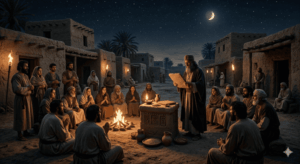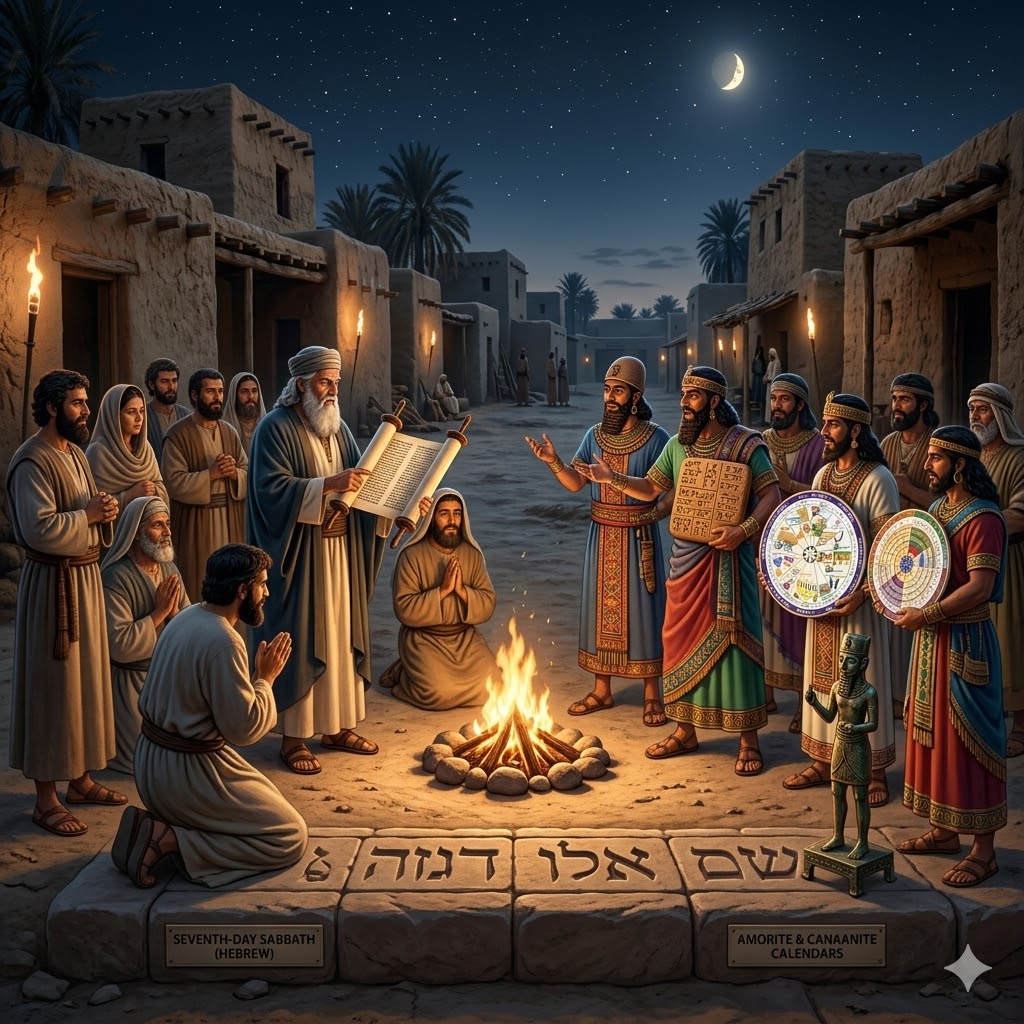

The seventh-day Sabbath predates every pagan religious calendar ever devised by ancient Near Eastern civilizations.
Secular scholars and critics have long attempted to locate the origin of the Sabbath within the religious calendars of the Amorites and Canaanites — arguing that Israel borrowed, adapted, or syncretized its sacred day of rest from surrounding cultures.
This article demonstrates, through Scripture and historical evidence, that the Sabbath was divinely instituted at Creation, encoded in cosmic law before any Amorite tribe or Canaanite city-state existed, and that the superficial resemblances found in ancient Near Eastern calendrical systems represent either dim reflections of original truth or corrupted imitations — never the source.
The Sabbath is not a cultural artifact but a Creation ordinance — a perpetual memorial of God’s creative act and His supreme authority as Lord of time.
Understanding how it contrasts with the religious calendars of the Amorites and Canaanites strengthens both the theological case for Sabbath observance and the apologetic response to historical revisionism.
I. The Creation Sabbath: Before Nations, Before Calendars
The Sabbath’s origin is unambiguous in Scripture. Genesis 2:2–3 records that God Himself rested on the seventh day, blessed it, and sanctified it — establishing a sacred rhythm of six days of labor followed by one day of holy rest.
This act occurred at the dawn of human history, thousands of years before the Amorites rose as a dominant people in Mesopotamia or Canaanite city-states developed their religious systems along the Levantine coast.
The significance of this chronological priority cannot be overstated. No human culture invented the seven-day week.
Anthropological and historical research consistently confirms that the seven-day cycle is anomalous among ancient timekeeping systems — most cultures used lunar months, ten-day decades (as in Egypt), or eight-day market cycles (as in Rome).
The near-universal emergence of the seven-day week across ancient civilizations points not to independent invention, but to a shared primordial memory of the Creation week — a memory that pagan cultures fragmented and distorted over centuries of apostasy.
“The Sabbath was not born in Babylon. It was born at the dawn of Creation, inscribed not in clay tablets but in the very structure of time itself.”
Biblical scholarship consistently affirms that the Sabbath was given to all humanity at Creation, not merely to Israel at Sinai.
The Sinai covenant formalized and re-declared what already existed in cosmic law.
Exodus 20:8–11 does not institute a new ordinance — it recalls one: “Remember the Sabbath day, to keep it holy.” The verb “remember” (Heb. zākar) presupposes prior existence.
God does not command His people to remember something that had not yet been given. The Sabbath was already written into the rhythm of time before Moses ever ascended the mountain.
II. Amorite Religious Calendars: Structure, Influence, and Limitation
The Amorites were a Semitic-speaking people who migrated from the Syrian steppe and gained significant cultural and political influence across Mesopotamia during the early second millennium BCE.
Their religious system was polytheistic, centered on storm gods (particularly Hadad), moon deities, and ancestral spirits. Their calendrical practices were primarily lunar, with months named after agricultural seasons, religious festivals, and ruling deities.
Some scholars have pointed to Amorite texts from Mari (on the Euphrates) that suggest awareness of special days within lunar cycles.
Certain administrative documents reference designated rest periods for workers or pauses in commercial activity at intervals that loosely correspond to quarter-moon phases.
Critics have used these references to argue that the Hebrew Sabbath was adapted from such Amorite practices.
However, this argument collapses under scrutiny. The Amorite “rest” periods were economically motivated pauses tied to lunar observation — not divinely commanded holy days.
They lacked the theological architecture of the Sabbath entirely: no Creation memorial, no covenant identity, no divine blessing or sanctification, and no perpetual weekly cycle independent of lunar phases.
The lunar quarter hypothesis also fails practically — lunar quarters do not divide evenly into a consistent seven-day week across months, resulting in variable “rest” intervals rather than the fixed seventh-day pattern commanded in Scripture.
To compare the Amorite administrative pause to the biblical Sabbath is like comparing a traffic light to the sun — both involve a moment of stopping, but their nature, origin, and purpose could not be more different.
III. Canaanite Religious Calendars: Fertility, Fear, and False Deities
The Canaanites who inhabited the land promised to Israel maintained one of the ancient world’s most developed polytheistic systems.
Their religious calendar was dominated by agricultural cycles tied to the worship of Baal (storm and fertility), Asherah (mother goddess), El (chief deity), and Mot (death).
Seasonal festivals marked the planting and harvest, the “death” of Baal in summer drought, and his “resurrection” with autumn rains.
Ugaritic texts — the most substantial surviving corpus of Canaanite religious literature, discovered at Ras Shamra in modern Syria — contain detailed records of Canaanite ritual calendars.
These texts reveal elaborate monthly and seasonal ceremonies, sacrificial schedules, and festival liturgies. Notably absent from the Ugaritic corpus is any evidence of a fixed, recurring seventh-day rest that resembles the biblical Sabbath in character, purpose, or theological grounding.
The Canaanite calendar was driven by appeasement — offerings were made to manipulate or placate unpredictable deities.
This stands in absolute contrast to the Sabbath, which was given not to appease God but to commemorate His completed and declared-good Creation.
The biblical Sabbath is joy, not fear. It is rest received from a loving Creator, not toil performed for a volatile deity.
“Where the Canaanite worshipper brought sacrifices to earn divine favor, the Sabbath-keeper rests because divine favor has already been declared — ‘And God saw everything that He had made, and behold, it was very good.'” (Genesis 1:31)
IV. The Babylonian Shapatu: Similarity Without Identity
Perhaps the most frequently cited parallel to the Sabbath in ancient Near Eastern studies is the Babylonian shapatu (also shabattu), a term appearing in Akkadian texts to describe the full moon — the fifteenth day of the lunar month.
Some nineteenth-century scholars seized on the phonetic similarity between shapatu and the Hebrew shabbat to argue direct borrowing.
This claim has been substantially weakened by subsequent scholarship including a detailed examination of the Akkadian and Babylonian calendar evidence.”.
The Babylonian shapatu referred to a single monthly event tied to the full moon, not a recurring weekly institution.
The “evil days” that Babylonian texts prescribed for caution on certain lunar intervals (the 7th, 14th, 19th, 21st, and 28th days of the month) were days of ill omen — periods when kings should not ride in chariots, eat certain foods, or make official pronouncements.
These were superstition-driven prohibitions, not holy convocations. They fell on irregular intervals (note the 19th rather than 21st) and were not available to ordinary people as rest days.
Biblical scholarship, supported by Old Testament scholars such as Niels-Erik Andreasen, holds that these superficial similarities reflect the common human awareness of sacred time — a residual echo of pre-Fall knowledge — rather than a source from which Israel borrowed.
The direction of dependence, if any exists, runs from the original Creation Sabbath outward into corrupted cultural memory, not the reverse. A corrupted copy does not become the original simply because it is older in its written form.
V. Israel’s Sabbath as Covenant Distinctive: A Counter-Cultural Institution
Far from being absorbed from Amorite or Canaanite practice, the Sabbath functioned in ancient Israel as a deliberately counter-cultural institution — one of the primary markers that separated covenant Israel from its polytheistic neighbors.
Ezekiel 20:12 states explicitly: “Moreover, I gave them my Sabbaths, as a sign between me and them, that they might know that I am the LORD who sanctifies them.”
The Sabbath was a sign of who Israel’s God was and what He had done — the exact opposite of Canaanite religion, which involved temple prostitution, child sacrifice to Molech, and divination.
To keep the Sabbath was to declare that one worshiped not the storm god Baal or the moon god Sin, but the Creator of heaven and earth who rested on the seventh day.
The prophets repeatedly connected Sabbath violation with Israel’s tendency toward Canaanite syncretism.
Isaiah 56:2–7, Jeremiah 17:19–27, and Nehemiah 13:15–22 all frame Sabbath desecration in terms of covenant unfaithfulness — the people were adopting the rhythms of pagan neighbors rather than the rhythm God had inscribed in time itself.
This prophetic framework makes no logical sense if the Sabbath had originated in pagan practice. One does not rebuke a nation for abandoning something they borrowed from the pagans in the first place.
The very seriousness of the prophetic rebuke confirms the Sabbath’s divine, non-pagan origin.
VI. The Eschatological Sabbath: A Creation Ordinance for All Time
Scripture presents the Sabbath not merely as a Mosaic institution confined to the old covenant economy — it is a Creation ordinance with eschatological significance that spans from the first Eden to the last. Isaiah 66:22–23 projects Sabbath worship into the new creation:
“And it shall come to pass, that from one new moon to another, and from one sabbath to another, shall all flesh come to worship before me, saith the LORD.”
This eschatological vision demolishes the theory that the Sabbath was a temporary cultural borrowing from Amorite or Canaanite contexts.
If the Sabbath were merely a concession to Near Eastern calendrical convention, it would have passed away with the Mosaic economy. Instead, Scripture anchors it to both the beginning and the end — Creation and new Creation — framing it as the eternal rhythm of life in the presence of God.
Hebrews 4:9–10 confirms this: “There remains, then, a Sabbath-rest for the people of God; for anyone who enters God’s rest also rests from their works, just as God did from his.”
The author of Hebrews does not point to Babylon or Canaan as the source of this rest.
He points to Genesis — to the God who rested on the seventh day and invites His people into that same rest, now and in the age to come.
Conclusion: The Sabbath Stands Apart
The attempt to derive the biblical Sabbath from Amorite administrative pauses or Canaanite lunar festivals fails on historical, theological, and exegetical grounds.
The Amorite calendrical system lacked the theological architecture of the Sabbath. The Canaanite religious calendar was an instrument of fear and appeasement, not a memorial of a good Creator.
The Babylonian shapatu was a lunar event tied to ill-omened days, not a divinely blessed day of rest and holy convocation.
The seventh-day Sabbath was created, not copied. It was given at the dawn of time by the God who made time — inscribed into the structure of the week before any human civilization arose to distort it.
Defending the Sabbath’s divine origin is not merely an academic exercise. It is an affirmation of who God is: the sovereign Creator whose memorial of rest stands unaltered by centuries of pagan counterfeiting, theological compromise, or historical revisionism.
The Sabbath does not belong to Canaan. It belongs to Eden — and to the new Eden yet to come.
References
- Andreasen, Niels-Erik A. The Old Testament Sabbath: A Tradition-Historical Investigation. Society of Biblical Literature, 1972.
- Bacchiocchi, Samuele. Divine Rest for Human Restlessness: A Theological Study of the Good News of the Sabbath for Today. Biblical Perspectives, 1988.
- Bacchiocchi, Samuele. From Sabbath to Sunday: A Historical Investigation of the Rise of Sunday Observance in Early Christianity. Pontifical Gregorian University Press, 1977.
- Chirichigno, Gregory C. “A Theological Investigation of Motivation in Old Testament Law.” Journal of the Evangelical Theological Society 24, no. 4 (1981): 303–313.
- Cross, Frank Moore. Canaanite Myth and Hebrew Epic: Essays in the History of the Religion of Israel. Harvard University Press, 1973.
- Day, John. Yahweh and the Gods and Goddesses of Canaan. Sheffield Academic Press, 2000.
- Eliade, Mircea. The Sacred and the Profane: The Nature of Religion. Harcourt Brace, 1959.
- Hasel, Gerhard F. “The Sabbath in the Pentateuch.” In The Sabbath in Scripture and History, edited by Kenneth Strand. Review and Herald, 1982.
- Heschel, Abraham Joshua. The Sabbath: Its Meaning for Modern Man. Farrar, Straus and Giroux, 1951.
- Jacobsen, Thorkild. The Treasures of Darkness: A History of Mesopotamian Religion. Yale University Press, 1976.
- Jastrow, Morris. “The Original Character of the Hebrew Sabbath.” The American Journal of Theology 2, no. 2 (1898): 312–352.
- Kugel, James L. The God of Old: Inside the Lost World of the Bible. Free Press, 2003.
- Lemaire, André. “Mari, the Bible, and the Northwest Semitic World.” Biblical Archaeologist 47, no. 2 (1984): 101–108.
- Strand, Kenneth A., ed. The Sabbath in Scripture and History. Review and Herald Publishing Association, 1982.
- White, Ellen G. Patriarchs and Prophets. Review and Herald Publishing Association, 1890.
- White, Ellen G. The Desire of Ages. Pacific Press Publishing Association, 1898.
- Wyatt, Nicolas. Religious Texts from Ugarit: The Words of Ilimilku and His Colleagues. 2nd ed. Sheffield Academic Press, 2002.
- The Holy Bible
My Letter To A Sunday Keeper – Sabbath Documentary

The Days of Noah – Powerful Documentary (Video Format)

Bible Studies – Written Format