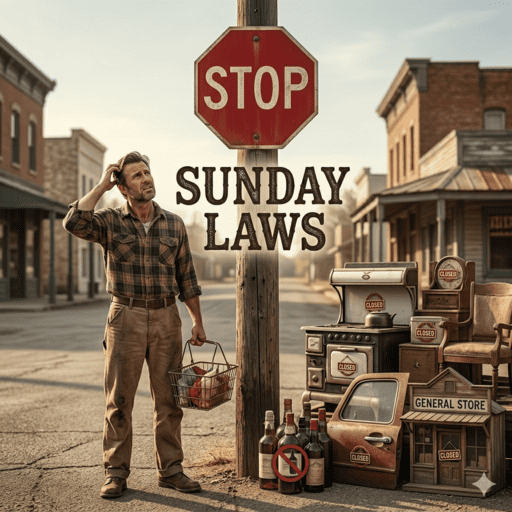

Sunday laws restrict commercial activity on Sundays. Governments enacted them to enforce religious observance or create a shared day of rest. Many still apply today across the United States and Europe.
What Are Sunday Laws?
A blue law is a colloquial term for a state statute or ordinance that forbids or regulates entertainment and commercial activities — such as the sale of liquor — on Sundays or religious holidays. Blue laws can also be referred to as Sunday closing laws, Sabbath laws, and uniform day of rest laws.
Blue laws date back to the colonial period. Patterned on existing English laws, they were intended to enforce the biblical commandment to “remember the Sabbath day and keep it holy.” These laws forbade certain activities on Sundays, including “worldly labor” and traveling.
Note: The biblical Sabbath is on the seventh day, and not on the first day – Sunday! (Genesis 2:2-3, Exodus 20:8-11)
The Roman Emperor Constantine promulgated the first known law regarding the prohibition of Sunday labor for religion-associated reasons in A.D. 321:
“On the venerable Day of the Sun let the magistrates and people residing in cities rest, and let all workshops be closed.” (History of the Christian Church, 1902 ed., vol. 3, p. 380)
Over time, the religious rationale faded. By the end of the colonial era, laws that banned everyday activities like housework and travel were largely lifted.
However, blue laws remained to prevent Sunday work and limit alcohol consumption. Today, they are largely justified on secular grounds — protecting workers, families, and public welfare.
Where Are Sunday Laws Still Enforced Today?
Blue laws commonly ban certain business and recreational activities on Sundays, and impose restrictions on the retail sale of hard goods and consumables, particularly alcoholic beverages.
While less prevalent today, they continue to be enforced in parts of the United States and Canada as well as in European countries, such as Austria, Germany, Norway, and Poland, where most stores are required to close on Sundays.
In the United States, enforcement has become fragmented. Rather than broad closures, most surviving Sunday laws target specific categories — alcohol, cars, or hunting.
At this point, the list of blue laws that have been repealed is much longer than the list of blue laws that are still enforced.
Common Types of Sunday Restrictions
Sunday laws today generally fall into a few predictable categories:
Alcohol sales — time-restricted or outright banned on Sundays in various states.
Car dealership closures — among the most widely surviving retail restrictions in the U.S.
Hunting bans — still enforced in several states through wildlife regulation laws.
General retail closures — rare in the U.S. but common across Europe, particularly Germany, Austria, and Poland.
Sunday Laws in the United States Today
Alcohol Sales Laws
Alcohol is the area where Sunday laws remain most active in the U.S., though the map is shrinking.
Only a few states ban all alcohol on Sundays entirely — it’s the case in Oklahoma and most of Mississippi. Other states like Tennessee and Indiana only ban alcohol during traditional church hours.
In Ohio, you need special permits for Sunday alcohol sales and cannot sell before 1 p.m. North Dakota bans off-premises liquor sales before noon.
Connecticut lifted its Sunday law banning alcohol sales in 2012, Delaware in 2003, and Minnesota in 2017. Arizona repealed its Sunday law, which limited alcohol sale hours, in 2010.
Sunday Hunting Restrictions
In Connecticut, Maine, North Carolina, Pennsylvania, and West Virginia, Sunday hunting is either fully prohibited or significantly limited under state law. In these states, restrictions often apply regardless of the type of game, though there may be narrow exceptions.
Pennsylvania recently made a significant shift. In 2025, Governor Josh Shapiro signed bipartisan legislation ending the ban on Sunday hunting, allowing the Game Commission to implement Sunday hunting opportunities.
Vehicle Sales Restrictions
In states such as Illinois, Indiana, Iowa, Maryland, Michigan, Minnesota, North Dakota, Oklahoma, and Pennsylvania, vehicle sales are prohibited on Sundays under state law.
This is one of the most widely surviving commercial restrictions in the country — dealers in these states simply cannot open their lots on Sundays regardless of customer demand.
Case Study: Bergen County Blue Laws
New Jersey’s Bergen County stands out as one of the most striking examples of surviving Sunday restrictions in the U.S.
Bergen County has one of the few non-liquor Sunday closing laws left in the U.S. You’re not allowed to sell electronics, clothing, or furniture.
Within Bergen County, Paramus has even more restrictive blue laws — all types of work are prohibited except grocery stores, gas stations, pharmacies, and parts of the hospitality and entertainment industry.
New Jersey’s Bergen County is one of the most well-known examples, where the sale of clothing, electronics, and furniture is prohibited on Sundays.
Other states also allow counties to opt in or out of certain Sunday restrictions, particularly involving alcohol sales.
Are Sunday Laws Constitutional?
Blue laws have frequently been challenged as unconstitutional establishments of religion in violation of the First Amendment. Despite this, they have repeatedly survived legal scrutiny.
Key Case: McGowan v. Maryland
McGowan v. Maryland, 366 U.S. 420 (1961), was a United States Supreme Court case that affirmed that the state’s Sunday closing laws did not have a religious purpose to aid religion and that the secular purpose of the legislation to set aside a day of rest and recreation did not violate the Establishment Clause.
The case arose when seven employees of a discount department store in Maryland were arrested for selling forbidden items on a Sunday.
The Court found that the laws did not violate the establishment clause, setting the precedent that laws with religious origins are constitutional if they have a secular purpose.
The Secular Purpose Doctrine
The Court’s reasoning in McGowan established a durable framework. The present purpose and effect of most Sunday closing laws is to provide a uniform day of rest for all citizens.
The fact that this day is Sunday, a day of particular significance for the dominant Christian sects, does not bar the State from achieving its secular goals.
While acknowledging the religious motivations behind the original blue laws, the Court emphasized their transformation into secular regulations addressing modern social needs.
The mere historical connection to religion did not render the laws unconstitutional.
This principle — that a law with religious roots can stand if it serves a genuine secular purpose — remains as law today, and is why Sunday restrictions on alcohol sales or car dealerships are rarely struck down by federal courts.
Sunday Laws in Europe and Canada
Europe maintains some of the most robust Sunday laws in the world, largely framed around worker protection rather than religion.
In Germany, Sundays and public holidays are constitutionally protected. Under article 139 of the Weimar Constitution — incorporated into the German Basic Law through article 140 — Sunday continues to be designated as a day of rest and spiritual elevation.
In general, all German state laws prohibit shops from opening on Sundays and public holidays. All federal states permit shops to open on at least three Sundays or public holidays per year.
Berlin allows up to eight exceptions per year, while Mecklenburg-Vorpommern and Baden-Württemberg permit only three.
Austria keeps most stores closed with limited Sunday openings permitted on a few designated days and in tourist zones. Poland has among Europe’s strictest rules since 2018, with most Sundays closed and only a handful of designated shopping Sundays per year.
France abolished its shopping ban for Sundays in 2015. Municipalities received the authority to decide whether stores could open on Sunday. The restrictions on Sunday opening times in France are not religiously motivated, but based on the welfare of employees.
In Canada, Nova Scotia was the last province to prohibit year-round Sunday shopping until October 2006.
The Retail Business Uniform Closing Day Act previously allowed some stores — such as video rental outlets, pharmacies, and book stores — to open on Sundays, but department stores had to remain closed.
Most Canadian provinces now allow Sunday retail, though some municipalities maintain local restrictions.
Economic and Social Impact of Sunday Laws
The debate over Sunday laws is not purely legal or religious — it carries measurable economic consequences.
A study using GPS data to examine the effects of lifting North Dakota’s strict Sunday morning retail ban in 2019 found that after the repeal, Sunday morning visits to Walmart stores rose sharply, reducing cross-border travel and shifting shopping to preferred times and stores.
The consumer welfare loss from the ban was equivalent to an extra 1.4 miles per shopping trip, highlighting a trade-off between a day of shared rest and consumer flexibility.
On the other side of the ledger, a study published by MIT and Notre Dame economists in 2008 found that the repeal of blue laws led to decreased church attendance, decreased donations to churches, and increased alcohol and drug use among religious individuals.
A separate study found a sharp rise in drunken driving on Sundays in New Mexico after that state ended its Sunday alcohol ban.
For workers, Sunday laws function as labor protections. Both labor unions and trade associations have historically supported the legislation of blue laws.
In Europe especially, keeping Sunday free from commercial activity is framed less as religious enforcement and more as a guarantee of work-life balance.
Recent Trends and Policy Changes
The overall trajectory in the U.S. is toward repeal, though the pace varies by state and issue.
The number of states with blue laws related to alcohol has been shrinking for decades as state courts struck laws down or legislatures repealed them.
Pennsylvania is a useful bellwether: in 2025, Pennsylvania ended its long-standing ban on Sunday hunting, following years of failed repeal attempts. The state had already stripped most of its retail Sunday laws decades earlier.
In Brazil, employees celebrate as Sunday laws are enacted by law with 70,000 workers sent home in one Province alone.
At the same time, there are counter-currents.
Project 2025, published by the Heritage Foundation, contains a subsection titled “Sabbath Rest” that calls on Congress to encourage “communal rest” by amending the Fair Labor Standards Act to require time-and-a-half pay for working on “the Sabbath,” which would default to Sunday.
Critics view this as an attempt to reintroduce Sunday restrictions through labor law rather than direct commercial regulation.
In Europe, the trend is mixed. Several countries lifted Sunday restrictions in recent years, including Denmark in 2012, Finland and Hungary in 2016. On the other hand, Poland introduced one of Europe’s strictest bans in 2018, closing almost all stores on Sundays.
Key Takeaways
Sunday laws (blue laws) restrict commercial and recreational activity on Sundays, rooted in colonial-era religious mandates but now often justified on secular grounds.
In the United States, most broad Sunday restrictions have been repealed. What remains is concentrated in alcohol sales timings, car dealership closures, and hunting bans — with Bergen County, NJ as a rare example of comprehensive retail restrictions surviving into the present day.
The Supreme Court has upheld Sunday laws as constitutional under the secular purpose doctrine established in McGowan v. Maryland (1961), holding that promoting a uniform day of rest is a valid government interest regardless of religious origins.
In Europe, countries like Germany, Austria, and Poland maintain robust Sunday closing laws, grounded more in worker protection and constitutional tradition than in religion.
Economically, Sunday restrictions create measurable consumer inconvenience but may also support worker welfare and community cohesion — a trade-off that continues to divide policymakers.
The overall trend is repeal, but Sunday laws are far from gone. They continue to shape when and how millions of people in the U.S. and abroad can shop, hunt, buy a car, or have a drink.
Conclusion
One thing is sure! Sunday is being exalted more and more. It is being presented as the solution to many of our current problems!
Whether it is for rest, for the environment, for the economy, for workers’ benefit, for family and Church, Sunday is the day of rest for all. No exceptions!
This growing movement to legislate Sunday as the common day of worship is precisely the union of church and state and the elevation of a false sabbath.
Prophecy has foretold that this development will eventually lead to national and international pressure to observe Sunday as a sacred day, fulfilling the biblical prediction of the mark of the beast in Revelation 13.
The time will come when every person on this planet must make a choice.
Should we listen and obey God’s seventh day Sabbath as outlined in Exodus 20:8-11 or should we listen to man made holy day like Sunday?
Revelation 14:9-11 is the last message of warning before the Creator of the Universe will come again to make Judgement on this Earth.
Sources
- Wikipedia — Blue Laws in the United States: https://en.wikipedia.org/wiki/Blue_laws_in_the_United_States
- Wikipedia — Blue Law: https://en.wikipedia.org/wiki/Blue_law
- Wikipedia — Sunday Shopping: https://en.wikipedia.org/wiki/Sunday_shopping
- TIPS (Training for Intervention ProcedureS) — What Are Sunday Blue Laws?: https://www.gettips.com/blog/sunday-blue-laws
- History.com — What Are “Blue Laws”—and Why Did America Adopt Them?: https://www.history.com/articles/blue-laws-sunday
- World Population Review — Blue Laws by State 2026: https://worldpopulationreview.com/state-rankings/blue-laws-by-state
- Cornell Law School / Legal Information Institute — Blue Law: https://www.law.cornell.edu/wex/blue_law
- Wikipedia — McGowan v. Maryland: https://en.wikipedia.org/wiki/McGowan_v._Maryland
- First Amendment Encyclopedia (MTSU) — McGowan v. Maryland (1961): https://firstamendment.mtsu.edu/article/mcgowan-v-maryland/
- Library of Congress (In Custodia Legis) — Shop Closing Laws in Germany: https://blogs.loc.gov/law/2025/11/shop-closing-laws-in-germany/
- CEPR / VoxEU — The Hidden Toll of Sunday Store Closures: New Evidence from GPS Data: https://cepr.org/voxeu/columns/hidden-toll-sunday-store-closures-new-evidence-gps-data
- CNE News — Overview: Germany Closes an Unmanned Shop on Sunday; How Pious is Europe?: https://cne.news/article/4058
- Freethought Today — Project 2025 Wants to Bring Back Blue Laws: https://www.freethoughttoday.com/articles/vol-41-no-09-november-2024
- https://adventmessenger.org/employees-celebrate-as-sunday-laws-take-effect-in-brazil-with-70000-workers-sent-home-in-one-province-alone/
- https://adventmessenger.org/blaze-media-how-about-no-sports-on-sundays-lets-put-those-laws-into-effect/
- https://adventmessenger.org/catholic-action-groups-in-eight-european-nations-urge-lawmakers-to-make-sunday-the-common-day-of-rest/
- http://adventmessenger.org/the-left-and-right-in-montenegros-parliament-unite-to-enforce-sunday-rest-by-law/
- (History of the Christian Church, 1902 ed., vol. 3, p. 380)
- Project 2025: Sunday Observance Enforced By Law | Your Freedom Under Attack
- Christian Nationalism and the Mark of the Beast 666 Connection
My Letter To A Sunday Keeper – Sabbath Documentary

The Days of Noah – Powerful Documentary (Video Format)

Bible Studies – Written Format